


LC UPC to SC APC Simplex Armored Fiber Patch Cable, OS2, Riser (OFCR)
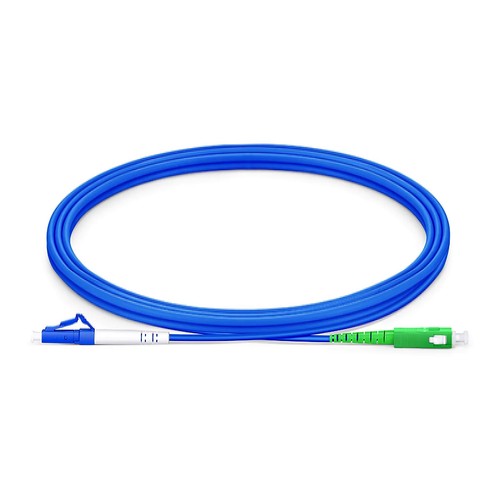
Malaysian upgrade projects can use this configuration where its interface and fiber map align with both the installed cabling and the new hardware. This hybrid simplex armored patch cable puts an LC UPC connector on one end and an SC APC connector on the other, joined by a single OS2 9/125µm fiber inside a helical stainless steel tube and blue 3.0mm riser-rated (OFCR) jacket. It is built for the common access-network case where the active hardware speaks LC but the optical distribution network presents an angled SC interface.
Product Highlights
- LC UPC to SC APC hybrid simplex, OS2 9/125µm single mode
- Connects LC equipment directly to APC-terminated ODN plant
- Helical stainless steel armor against crush, impact and rodents
- G.657.A1 bend-insensitive fiber, 10/5D bend radius
- Riser (OFCR) flame rating for vertical building pathways
- Stock lengths 1m to 30m; custom lengths and jackets on request
Specifications
| Connector Type | LC to SC |
|---|---|
| Polish Type | UPC to APC |
| Fiber Mode | OS2 9/125µm |
| Wavelength | 1310/1550nm |
| Fiber Count | Simplex |
| Fiber Grade | G.657.A1 (Compatible with G.652.D) |
| Min. Bend Radius (Fiber Cable) | 10/5D (Dynamic/Static) |
| Cable Outside Diameter (OD) | 3.0mm |
| Flame Rating | Riser (OFCR) |
| Construction Type | Single Armored, Stainless Steel Tube |
| Tensile Strength | 120/225N (Long/Short Term) |
| Insertion Loss | ≤0.3dB |
| Return Loss | ≥50dB (UPC) / ≥60dB (APC) |
| Operating Temperature | -20 to 70°C (-4 to 158°F) |
| Storage Temperature | -40 to 70°C (-40 to 158°F) |
A hybrid cord between transceiver and ODN
FTTx and access deployments constantly bridge two interface worlds: the OLT, media converter or test set with LC ports on one side, and the distribution frame or wall outlet terminated with SC APC on the other. A hybrid cord makes that transition in one tested assembly instead of stacking an adapter onto a standard jumper, removing a mated pair and its loss from the link. Malaysian upgrade teams can use this detail to compare the new assembly with the installed cabling records.
Mixed polish on one assembly, and why it matters
The UPC end is flat-polished for the connected hardware side; the APC end is ground at 8 degrees to mate with the angled plant. UPC and APC connectors must never be mated to one another: the angled and flat end faces meet at a gap that destroys return loss and might chip the fiber. This cord is built so every end meets only the interface it was polished for.
Armored for the last exposed meters
Hybrid access tails run through the least controlled part of the network: customer wall boxes, cabinet doors, basement risers and pole-top enclosures. The helical steel tube inside the jacket gives the cord crush and rodent resistance exactly where the fixed plant might no longer protect it, without sleeving the run in conduit.
Typical applications for the hybrid build
The common three: connecting LC-port OLT or test hardware to an SC APC distribution frame, jumpering between an ONT with LC pigtail access and the APC wall outlet, and lab setups where LC-based instruments must exercise APC plant. In all three the hybrid cord replaces an adapter-plus-jumper stack, removing one mated pair from the link and one source of intermittent loss from the trouble report.
Available lengths and custom orders
Normal length options are stocked for fast delivery: 1m (3ft), 2m (7ft), 3m (10ft), 5m (16ft), 10m (33ft), 15m (49ft), 20m (66ft) and 30m (98ft), covering the common rack-to-rack, access and frame connections this cord is built for. Customized cable lengths beyond this range are manufactured to order. For access tails, measure from the connected hardware port to the frame position and order to that figure; the cord then dresses without a service loop trapped behind the enclosure. Specifying the exact route length avoids the two the slack storage problem of an overlong cord and the strain risk of one that is too short.
Testing and inspection practice
Each hybrid assembly is terminated with precision zirconia ferrules, with the APC end angle-verified and the two terminations geometry-checked. Insertion loss and return loss are measured through the finished cord before packing, meaning that the 0.3dB insertion ceiling and the 50/60dB return figures describe the delivered assembly, not a lab sample.
Ordering and Customization Support
Refer to the LC UPC to SC APC simplex armored family when seeking a quotation, and state the route length and jacket rating. If the plant uses a different connector mix, the project-specific simplex armored program builds any combination once the factory confirms the specification. For Malaysian upgrades, our team can compare the requested build with the existing environment before production begins.
Transceivers
Malaysia Fiber Optic Supplier
Malaysia Fiber OpticsFactory Address: Block 5, Wangtang Industrial Park,Nanshan Area, Shenzhen,China
Malaysia Office: 68000 Ampang,
Selangor, MYhttps://www.fiberoptic.com.my