


LC to LC Duplex Armored Fiber Patch Cable, OS2, Riser (OFCR)
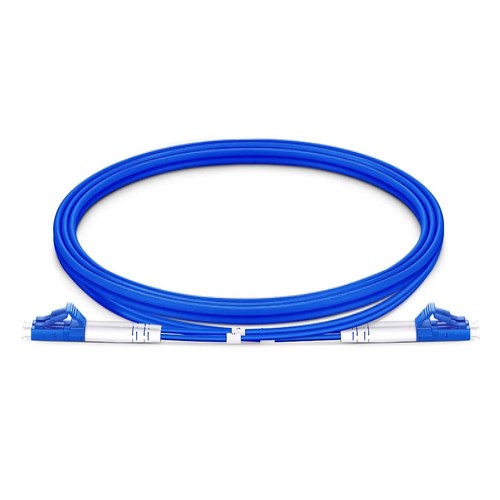
Malaysian upgrade projects can use this configuration where its interface and fiber map align with both the installed cabling and the new hardware. This duplex armored patch cable pairs two LC UPC connectors on an OS2 9/125µm single-mode assembly protected by a helical stainless steel tube. The 3.0mm riser-rated (OFCR) jacket keeps the completed cable flexible enough for cabinet and under-floor routing while the steel armor absorbs crushing, pulling and rodent damage that would interrupt an ordinary patch cord. G.657.A1 bend-insensitive glass keeps attenuation stable even where the pathway turns tightly around trays and rack posts.
Product Highlights
- LC UPC to LC UPC duplex, OS2 9/125µm single mode
- Helical stainless steel armor against crush, impact and rodents
- G.657.A1 bend-insensitive fiber, 10/5D dynamic/static bend radius
- Riser (OFCR) flame rating for vertical building pathways
- Insertion loss ≤0.3dB, return loss ≥50dB
- Stock lengths 1m to 30m; custom lengths and jackets on request
Specifications
| Connector Type | LC to LC |
|---|---|
| Polish Type | UPC to UPC |
| Fiber Mode | OS2 9/125µm |
| Wavelength | 1310/1550nm |
| Fiber Count | Duplex |
| Fiber Grade | G.657.A1 (Compatible with G.652.D) |
| Min. Bend Radius (Fiber Cable) | 10/5D (Dynamic/Static) |
| Cable Outside Diameter (OD) | 3.0mm |
| Flame Rating | Riser (OFCR) |
| Construction Type | Single Armored, Stainless Steel Tube |
| Tensile Strength | 120/225N (Long/Short Term) |
| Insertion Loss | ≤0.3dB |
| Return Loss | ≥50dB |
| Operating Temperature | -20 to 70°C (-4 to 158°F) |
| Storage Temperature | -40 to 70°C (-40 to 158°F) |
Why steel armor instead of a conduit
Conventional patch cords depend on the surrounding duct or tray for mechanical protection. Where cables cross open floors, shared ceilings or industrial spaces, that protection is not equivalent to always available. The helical steel tube inside the finished assembly wraps the buffered fibers directly, meaning that the completed cable itself carries the crush and rodent resistance. Installers might route it through areas that would otherwise require metal conduit, which reduces the two material cost and fitting time while keeping the pathway smaller and easier to reconfigure later.
OS2 single-mode performance in duplex links
OS2 glass at 1310/1550nm supports the long-reach single-mode optics used in campus backbones, carrier access networks and data center interconnects. The duplex LC interface is the standard connection for SFP, SFP+, SFP28, QSFP+ and QSFP28 transceivers, meaning that one cable family covers links from 1G through 100G and beyond. G.657.A1 bend tolerance is fully compatible with legacy G.652.D plant, which means the completed cable can generally be mixed into current single-mode infrastructure without changing loss budgets.
Understanding the OFCR riser rating
OFCR stands for optical fiber conductive riser: a riser-rated cable whose metallic armor makes it conductive under building codes. The riser rating permits vertical runs between floors in shafts and riser closets. Where the pathway passes through air-handling spaces, a plenum (OFNP) version should be chosen instead; where low smoke and zero halogen are specified, the LSZH variant of this same LC-LC construction is available. Matching the jacket to the building section is part of the ordering discussion, not an afterthought.
Where armored duplex cords are deployed
The typical homes for this cord are data center cross-connect fields, campus backbone handoffs, industrial control rooms and any pathway shared with power cabling or foot traffic. In every case the pattern is the same: the route is fixed, the cord is handled during each reconfiguration, and an unprotected jumper would eventually be crushed, kinked or chewed. The armored build removes that failure mode without changing how the cord dresses or connects.
Available lengths and custom orders
Normal length options are stocked for fast delivery: 1m (3ft), 2m (7ft), 3m (10ft), 5m (16ft), 10m (33ft), 15m (49ft), 20m (66ft) and 30m (98ft), covering the common rack-to-rack, access and frame connections this cord is built for. Customized cable lengths beyond this range are manufactured to order. The same construction might also be supplied with black or white jackets, APC polish, or alternative connectors through the project-specific duplex armored cable program. Specifying the exact route length avoids the two the slack storage problem of an overlong cord and the strain risk of one that is too short.
Testing and inspection practice
Each finished assembly is terminated with precision zirconia ferrule connectors and measured for insertion loss and return loss before packing. The 0.3dB insertion loss ceiling and 50dB minimum return loss are verified ratings, not design targets. End-face geometry is checked to keep the physical contact consistent across repeat mating, and the ferrules are rated for up to one thousand insertion cycles, which matters in patching fields that are reconfigured frequently.
Ordering and Customization Support
Refer to the LC-LC OS2 duplex armored family when seeking a quotation and state the route length, jacket rating and connector polish appropriate. For non-standard combinations of length, color, connector or jacket, send the need with the inquiry and the factory will determine the manufacturable specification before the product is built. For Malaysian upgrades, our team can compare the requested build with the existing environment before production begins.
Transceivers
Malaysia Fiber Optic Supplier
Malaysia Fiber OpticsFactory Address: Block 5, Wangtang Industrial Park,Nanshan Area, Shenzhen,China
Malaysia Office: 68000 Ampang,
Selangor, MYhttps://www.fiberoptic.com.my