


Custom Simplex Armored Fiber Patch Cable, OS2, LC/SC/FC/ST/LSH
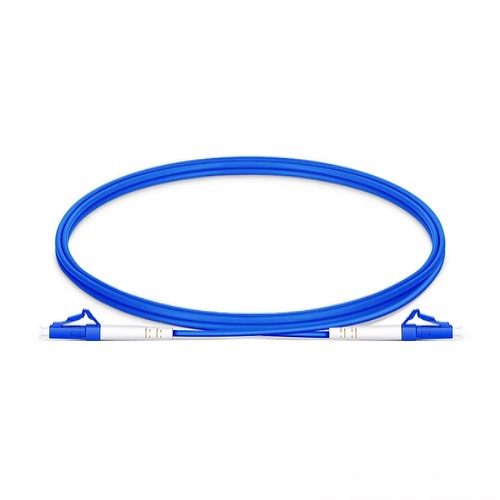
Malaysian upgrade projects can use this configuration where its interface and fiber map align with both the installed cabling and the new hardware. This is the configured-to-order simplex armored platform: a single OS2 9/125µm G.657.A1 fiber inside a helical stainless steel tube, terminated with any mix of LC, SC, FC, ST or LSH connectors in UPC or APC polish, under a riser (OFCR), LSZH or plenum (OFNP) jacket in blue, black or white. It is the build for BiDi links, monitoring taps, test access and each other single-fiber application that stock cords do not quite match.
Product Highlights
- Simplex OS2 9/125µm, built to the stated configuration
- LC, SC, FC, ST or LSH connectors in any end-to-end mix
- UPC or APC polish per end, return loss to 60/65dB class
- Riser (OFCR), LSZH or plenum (OFNP) jacket, blue/black/white
- Helical stainless steel armor, 120/225N tensile rating
- Any length to order; standard range 1m to 30m stocked
Specifications
| Connector Type | LC / SC / FC / ST / LSH, any end-to-end combination |
|---|---|
| Polish Type | UPC or APC per end |
| Fiber Mode | OS2 9/125µm |
| Wavelength | 1310/1550nm |
| Fiber Count | Simplex |
| Polarity | A (Tx) to B (Rx) |
| Jacket Color | Blue / Black / White |
| Cable Outside Diameter (OD) | 3.0mm |
| Fiber Grade | G.657.A1 (Compatible with G.652.D) |
| Min. Bend Radius (Fiber Cable) | 10/5D (Dynamic/Static) |
| Flame Rating | Riser (OFCR) / LSZH / Plenum (OFNP) |
| Construction Type | Single Armored, Stainless Steel Tube |
| Tensile Strength | 120/225N (Long/Short Term) |
| Insertion Loss | ≤0.3dB |
| Return Loss | UPC ≥50dB, APC ≥60dB (LC/SC/FC/ST); LSH APC ≥65dB |
| Operating Temperature | OFNP: 0 to 70°C; OFCR/LSZH: -20 to 70°C |
| Storage Temperature | -40 to 70°C (-40 to 158°F) |
Simplex configurations for BiDi and monitoring
Single-fiber transmission has become the default in access and increasingly in the data center: BiDi optics, WDM systems, monitoring taps and test access ports all light exactly one strand. A made-to-order simplex cord matches that reality precisely, including hybrid builds such as LC UPC toward the transceiver and SC APC toward the distribution plant.
Connector and polish options
LC, SC, FC, ST and LSH bodies are all in the program, with UPC or APC polish selected per end. That covers the awkward one-offs that stall projects: a FC-equipped OTDR launch lead, an ST legacy panel, an LSH carrier frame, or an APC plant that must meet UPC hardware. Every combination is terminated and tested as a single assembly.
Jacket, color and pathway
The jacket rating follows the building zone: riser (OFCR) for general and vertical pathways, LSZH for occupied public spaces, plenum (OFNP) for air-handling space. Blue is the standard single-mode color; black and white serve color-coded administration schemes or discreet routing in finished interiors. Malaysian upgrade teams can use this detail to compare the new assembly with the installed cabling records.
Test leads and launch cords
Made-to-order simplex armored builds are frequently ordered as OTDR launch and receive leads, reference cords for loss test sets, and lab jumpers that get connected and disconnected all day. The armored tube protects the reference-grade termination from the handling that destroys ordinary lab cords, and the polish and connector can generally be matched exactly to the instrument and the plant under test.
Access-network repairs and restoration
Simplex armored customs are a practical restoration kit: when a drop tail or frame jumper is damaged, a hybrid replacement can generally be built to the exact failed combination and shipped without waiting for a distributor to stock the oddball. Keeping the failed connector types, polish and length in the trouble report is all the factory needs to determine the build, which turns a multi-day sourcing problem into a single inquiry.
Available lengths and custom orders
Normal length options are stocked for fast delivery: 1m (3ft), 2m (7ft), 3m (10ft), 5m (16ft), 10m (33ft), 15m (49ft), 20m (66ft) and 30m (98ft). Since each cord is built to order, any length between or beyond these sizes can generally be produced, which is how most access tails and test leads are actually specified.
Testing and inspection practice
Made-to-order simplex cords are verified to the same limits as the stock range: 0.3dB insertion loss ceiling and polish-right return loss measured on each finished assembly. APC ends are angle-verified, all ferrules are geometry-checked, and the tested figures ship with the batch documentation.
Ordering and Customization Support
Send the mating connector types and polish per end, the jacket rating, color and length. The factory confirms the manufacturable specification and lead time with the quotation; photos or drawings of the current interfaces help avoid polish mismatches before the product is built. For Malaysian upgrades, our team can compare the requested build with the existing environment before production begins.
Transceivers
Malaysia Fiber Optic Supplier
Malaysia Fiber OpticsFactory Address: Block 5, Wangtang Industrial Park,Nanshan Area, Shenzhen,China
Malaysia Office: 68000 Ampang,
Selangor, MYhttps://www.fiberoptic.com.my