


12 Fibers MPO Female Type 1 Attenuated Fiber Loopback Module, OS2, 3dB
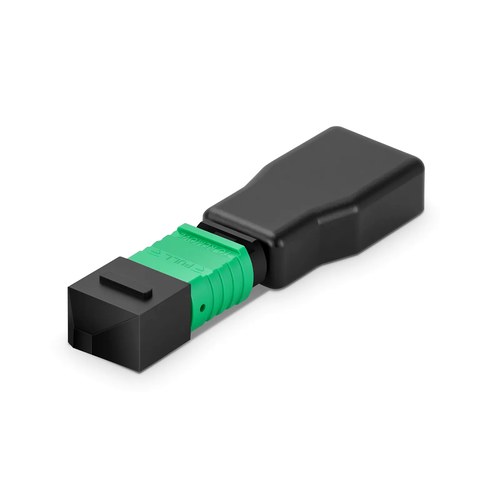
Our 12 loopback module is a simple, reliable tool for validating multi-fiber ports before go-live. The internal fiber path is factory measured, and the housing is small enough to keep in every field toolkit.
Product Highlights
- Fiber Type: OS2 9/125μm
- Fiber Connector: MPO Female, APC
- Attenuation: 3dB
- Attenuation Tolerance: ±0.7dB
- Insertion Loss: SM (G657.A2) ≤1.5dB
- Factory tested, individually packed
Specifications
| Part Number | LPM-SM-12MPO |
|---|---|
| Manufacturer | HT |
| Fiber Type | OS2 9/125μm |
| Fiber Connector | MPO Female, APC |
| Attenuation | 3dB |
| Attenuation Tolerance | ±0.7dB |
| Insertion Loss | SM (G657.A2) ≤1.5dB |
| Return Loss | ≥60dB |
| Insert-Pull Test | 50 times, IL Change<0.6dB |
| Test Wavelength | 1260/1620nm |
| Housing Material | PC |
| Dimensions (HxWxD) | 16x8.5x54mm |
| Operating Temperature | -40 to 75°C (-40 to 167°F) |
| Storage Temperature | -40 to 75°C (-40 to 167°F) |
Applications
Typical uses are switch and NIC port validation in production, burn-in testing before shipment, troubleshooting suspect links in the field, and verifying cabling channels end to end. It lets a single technician confirm that a parallel port transmits and receives correctly on every lane.
Using the Loopback Correctly
A loopback contains no electronics: it simply connects transmit fibers to receive fibers inside the housing. The port under test sees its own signal returned, so link indicators and diagnostics behave as if a far-end device were connected. Always check the required attenuation for high power interfaces.
Ordering Information
To order, quote LPM-SM-12MPO together with the length and quantity you need. Private labeling, custom packaging and project specific documentation are all handled in-house.
Built to Your Spec
Our engineering team handles custom MPO/MTP assemblies daily. If the standard configuration does not match your link design, send us the requirement and we will build exactly what your network needs at factory-direct cost.
Quality and Testing
Every MPO/MTP assembly leaving our factory is 100% tested for insertion loss and return loss, with end face geometry checks on the multi-fiber ferrules. Controlled polishing keeps the loss budget stable across the whole batch, which matters when several mated pairs sit in one link.
How We Pack
Each assembly is coiled, capped and sealed in an individual bag, then packed into foam lined export cartons. Test reports can be attached per unit or per batch, and carton marks follow your shipping instructions.
Transceivers
Malaysia Fiber Optic Supplier
Malaysia Fiber OpticsFactory Address: Block 5, Wangtang Industrial Park,Nanshan Area, Shenzhen,China
Malaysia Office: 68000 Ampang,
Selangor, MYhttps://www.fiberoptic.com.my