


LC to LC Duplex FTTA Outdoor Patch Cable, OS2, 7.0mm LSZH
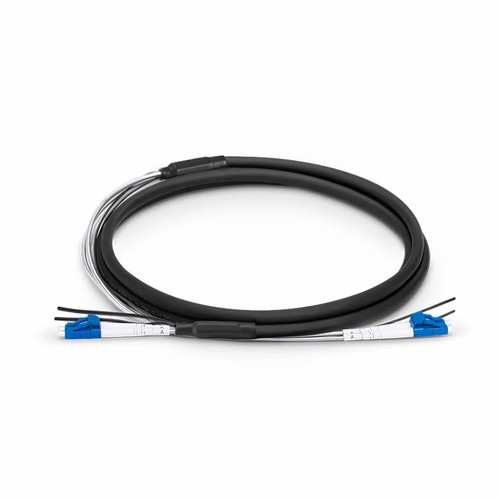
Malaysian upgrade projects can use this configuration where its interface and fiber map align with both the installed cabling and the new hardware. This duplex FTTA patch cable connects the baseband unit at the foot of the tower to the remote radio unit at the top, carrying two OS2 9/125µm single-mode fibers inside a 7.0mm LSZH outdoor jacket. The two terminations terminate in LC UPC duplex connectors that plug directly into the SFP and SFP+ ports of common LTE, 4G and 5G radio systems. The completed cable core is Corning G.657.A1 bend-insensitive glass, and every branch leg is protected by a helical steel armored branch tube, meaning that the finished product survives pulling, bird damage and rodents across years of outdoor exposure.
Product Highlights
- LC UPC to LC UPC duplex, OS2 9/125µm single mode
- Corning G.657.A1 bend-insensitive fiber, 20/10D bend radius
- 7.0mm LSZH outer jacket, UV stabilized and flame retardant
- Helical steel armored branch, anti-rodent and bird-proof
- Tensile strength 200/400N, crush resistance 1100/2200N
- Stock lengths 1m to 50m; project lengths on request
Specifications
| Connector Type | LC to LC |
|---|---|
| Polish Type | UPC to UPC |
| Fiber Mode | OS2 9/125µm |
| Wavelength | 1310/1550nm |
| Fiber Count | Duplex / 2 Fibers |
| Fiber Grade | Corning G.657.A1 |
| Min. Bend Radius (Fiber Cable) | 20/10D (Dynamic/Static) |
| Attenuation at 1310nm | ≤0.36dB/km |
| Attenuation at 1550nm | ≤0.22dB/km |
| Cable Jacket | Low Smoke Zero Halogen (LSZH) |
| Cable Diameter (Outer/Inner) | 7.0/2.0mm |
| Armored Breakout Length (End A/B) | 0.03/0.34m (0.2m optional) |
| Tensile Strength | 200/400N (Long/Short Term) |
| Crush Resistance | 1100/2200N (Long/Short Term) |
| Insertion Loss | ≤0.3dB |
| Return Loss | ≥50dB |
| Operating Temperature | -20 to 70°C (-4 to 158°F) |
| Storage Temperature | -40 to 80°C (-40 to 176°F) |
Built for the BBU to RRU link
Modern base station architecture separates the baseband unit (BBU) in the shelter or cabinet from the remote radio unit (RRU) mounted beside the antenna. The link between them carries CPRI or eCPRI traffic over duplex single-mode fiber, and it is the most in mechanical terms stressed jumper in the network: it hangs vertically on the tower, flexes in the wind, and is exposed to ultraviolet radiation, rain and temperature cycling each day of its service life. The supplied cable is engineered for exactly that run, with a jacket and strength system rated for outdoor fitting rather than adapted from an indoor patch cord.
Why the armored branch matters on a tower
The last meters of an FTTA run are the most vulnerable. Where this trunk assembly breaks out into legs at the RRU end, standard 2.0mm tails can generally be crushed by clamps, chewed by rodents or pecked open by birds. Every branch leg of the finished assembly is sleeved in a helical stainless steel tube that keeps the branch flexible while adding real crush and bite resistance. The breakout point is potted and strain-relieved, meaning that tower vibration and handling loads never reach the ferrule end-faces.
G.657.A1 glass in tight tower routing
Cable routing on a monopole or lattice tower rarely makes it possible for generous sweep bends. G.657.A1 bend-insensitive fiber tolerates a 10D static and 20D dynamic bend radius, meaning that the completed cable can generally be dressed through cable glands, tight tray entries and the crowded junction box at the tower base without adding macrobend loss. The glass remains fully compatible with legacy G.652.D single-mode plant, which keeps the link channel loss calculation unchanged when this jumper assembly connects into older feeder fiber.
LSZH jacket for mixed indoor-outdoor routes
Many FTTA runs start inside a hardware shelter, pass through a wall gland and continue outdoors up the tower. A single cable that is legal for the two zones simplifies the bill of materials: the low smoke zero halogen jacket meets indoor fire expectations while its UV-stabilized, chemically resistant compound handles years of outdoor exposure. There is no transition point, no extra enclosure, and one less splice in the channel budget.
Available lengths and custom orders
Normal length options are stocked for fast delivery: 1m (3ft), 2m (7ft), 3m (10ft), 5m (16ft), 10m (33ft), 20m (66ft), 30m (98ft) and 50m (164ft), covering the common shelter-to-tower and frame-to-radio runs this cord is built for. Customized cable lengths beyond this range are manufactured to order. For tower runs, measure the route from the BBU patching field to the RRU port with the completed cable tray path included, then add working slack at the two terminations; an accurately ordered length avoids a service loop hanging on the structure. Specifying the exact route length avoids the two the slack storage problem of an overlong cord and the strain risk of one that is too short.
Testing and inspection practice
Each finished assembly is terminated with precision zirconia ferrule connectors and optically tested before packing: insertion loss is verified against the 0.3dB ceiling and return loss against the 50dB minimum on every branch leg, not on a sample basis. End-face geometry is inspected for consistent physical contact, and the completed cable is proof-checked so that the delivered jumper can generally be plugged in and put into service without on-site rework.
Ordering and Customization Support
Refer to the LC-LC duplex FTTA family when seeking a quotation and state the route length and the breakout style appropriate at the RRU end. For connector mixes other than LC to LC, or for non-standard breakout lengths, the project-specific FTTA program covers the same cable platform; send the need with the inquiry and the factory will determine the manufacturable specification before the product is built. For Malaysian upgrades, our team can compare the requested build with the existing environment before production begins.
Transceivers
Malaysia Fiber Optic Supplier
Malaysia Fiber OpticsFactory Address: Block 5, Wangtang Industrial Park,Nanshan Area, Shenzhen,China
Malaysia Office: 68000 Ampang,
Selangor, MYhttps://www.fiberoptic.com.my