


Custom LC/SC Simplex FTTA Outdoor Patch Cable, OS2, 7.0mm LSZH
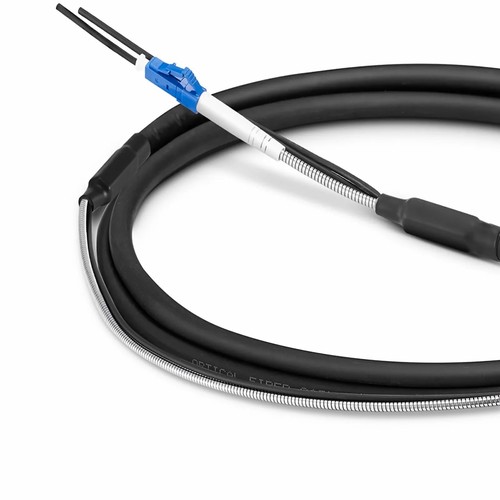
Malaysian upgrade projects can use this configuration where its interface and fiber map align with both the installed cabling and the new hardware. The project-specific simplex FTTA program builds the single-fiber outdoor base station jumper to the exact configuration of the link: LC or SC connectors in any mix, the measured route length, and an armored branch length matched to the exposed section at every end. It serves the bidirectional and single-fiber optics increasingly used on radio units, where one strand carries the two directions of traffic. The platform is the proven FTTA outdoor construction: one OS2 9/125µm single-mode fiber of Corning G.657.A1 glass in a 7.0mm LSZH jacket with helical steel armored protection over the tails.
Product Highlights
- Simplex OS2 9/125µm single mode for BiDi links
- LC, SC and mixed LC/SC combinations to order
- Corning G.657.A1 bend-insensitive fiber, 20/10D bend radius
- Armored branch length matched to the exposed section
- 7.0mm LSZH UV-stabilized outdoor jacket
- Any project length manufactured to order
Specifications
| Connector Type | LC/SC, mix to order |
|---|---|
| Polish Type | UPC |
| Fiber Mode | OS2 9/125µm |
| Wavelength | 1310/1550nm |
| Fiber Count | Simplex / 1 Fiber |
| Fiber Grade | Corning G.657.A1 |
| Min. Bend Radius (Fiber Cable) | 20/10D (Dynamic/Static) |
| Attenuation at 1310nm | ≤0.36dB/km |
| Attenuation at 1550nm | ≤0.22dB/km |
| Cable Jacket | Low Smoke Zero Halogen (LSZH) |
| Cable Diameter (Outer/Inner) | 7.0/2.0mm |
| Armored Breakout Length (End A/B) | 0.03/0.34/0.2m, selectable |
| Tensile Strength | 200/400N (Long/Short Term) |
| Crush Resistance | 1100/2200N (Long/Short Term) |
| Insertion Loss | ≤0.3dB |
| Return Loss | ≥50dB |
| Operating Temperature | -20 to 70°C (-4 to 158°F) |
| Storage Temperature | -40 to 80°C (-40 to 176°F) |
A custom cord for single-fiber radio links
Bidirectional optics place transmit and receive on one strand, meaning that this jumper assembly between the baseband hardware and the radio needs exactly one fiber. Ordering that jumper as a made-to-order simplex cord matches the hardware precisely: the mating connector at every end follows the actual port, the length follows the measured route, and nothing is left over. Compared with adapting a duplex cord, the made-to-order simplex build removes the parked leg, halves the mating connector count on the record, and keeps the tower fitting as light as it can generally be.
Connector freedom at both ends
Radio units, enclosures and frames present LC and SC interfaces depending on vendor and generation. The made-to-order program terminates any mix of LC and SC on the same outdoor platform, polished and tested in the factory. A site that evolves from SC-based enclosures to LC-based radios is served by one cord with LC on one end and SC on the other, with no adaptors in the relevant optical path and no further mated pair in the channel loss calculation.
Outdoor mechanics unchanged
The project-specific cord keeps the full outdoor rating of the standard FTTA family: 200/400N long and short-term tensile strength for pulling and vertical hanging, 1100/2200N crush resistance, helical steel armored branches over the exposed tails, and an operating range from -20 to 70 degrees Celsius. The G.657.A1 fiber holds attenuation stable at the 10D static bends that appear inside congested enclosures and radio shrouds.
Repeatability across the rollout
For operators deploying the same radio configuration across many sites, the project-specific cord is specified once and repeated exactly: connector mix, length, armored branch and labelling. Each site receives the identical assembly, commissioning follows the same steps, and the spares holding stays minimal as one recorded configuration covers the whole fleet.
Available lengths and custom orders
State the measured route length with the inquiry, including the tray path and working slack at the two terminations; the factory builds to that figure and confirms the manufacturable specification before the product is built.
Testing and inspection practice
Every project-specific simplex cord is terminated with precision zirconia ferrule connectors and optically tested as a whole assembly: insertion loss is verified against the 0.3dB ceiling and return loss against the 50dB minimum. End-face geometry is inspected on each mating connector so the delivered cord can generally be plugged into service without on-site rework.
Ordering and Customization Support
Send the appropriate connector mix, route length and armored branch preference with the inquiry. The factory confirms the manufacturable specification before the product is built and keeps the configuration on record for repeat orders across the rollout. For Malaysian upgrades, our team can compare the requested build with the existing environment before production begins.
Transceivers
Malaysia Fiber Optic Supplier
Malaysia Fiber OpticsFactory Address: Block 5, Wangtang Industrial Park,Nanshan Area, Shenzhen,China
Malaysia Office: 68000 Ampang,
Selangor, MYhttps://www.fiberoptic.com.my