


LC to LC UPC Simplex OS2 Single Mode Fiber Optic Test Cable with 10dB Attenuator
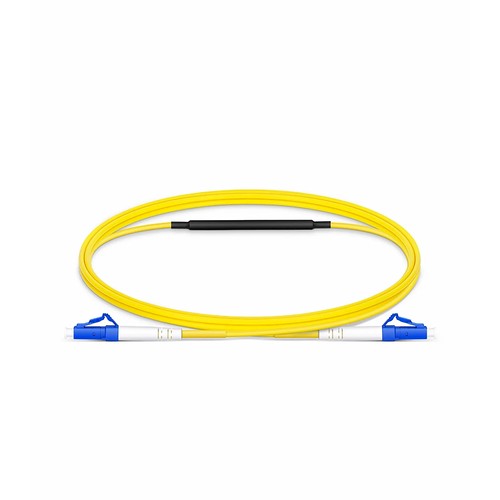
Malaysian upgrade projects can use this configuration where its interface and fiber map align with both the installed cabling and the new hardware. LC to LC UPC Simplex OS2 Single Mode Fiber Optic Test Cable with 10dB Attenuator combines a precision fixed attenuator with a test-grade patch cord in one assembly. It exists for one recurring job: proving that a long-reach transceiver works at its specified receive level without deploying the full fiber route. Plug it between the diagnostic module and the test set, and the 10 dB element reproduces the link loss the optics were designed to tolerate.
Product Highlights
- Applied for CWDM, DWDM, Test Equipment, CATV Systems, Point to Point Systems, etc.
- Attenuating Material-ion Doped Fiber
- 1310/1550nm Wavelength Singlemode Attenuators
- Precision Polishing for Reduced Back Reflection
- Standard Fixed Attenuation Value of 10dB
Specifications
| Attenuation | 10dB |
|---|---|
| Return Loss | ≥45dB |
| Operating Temperature Range | -25 to 70°C (-13 to 158°F) |
| Storage Temperature Range | -40 to 85°C (-40 to 185°F) |
| Application(1) | Specification(1) |
| Attenuation:15dB | Just what I needed, worked great. |
Why links need attenuation at all
Optical links are engineered with a power budget: the transmitter launches, the fiber and connectors consume, and the receiver expects what remains inside a defined window. Short routes, dense wavelength plans and high-power transmitters might all deliver too much light, and an overloaded receiver distorts exactly like an overloaded amplifier - errors appear on a link that tests perfectly on loss alone. A fixed attenuator brings the received power back inside the window, and the link behaves as designed.
Ion-doped fiber as the attenuating element
The cleanest way to attenuate light is to absorb it inside the fiber itself. Ion-doped fiber attenuators do exactly that: a short section of doped glass absorbs a calibrated fraction of the optical power and converts it to negligible heat. Because the attenuation happens inside the core, the light that emerges keeps its mode profile and the device adds virtually no reflectance. The alternatives - air gaps, offsets and misaligned ferrules - all trade loss against reflections and modal noise, which is why precision attenuators abandoned them. Malaysian upgrade teams can use this detail to compare the new assembly with the installed cabling records.
Attenuator test cables for transceiver qualification
Long-reach transceivers are specified to work over tens of kilometers of fiber; the test bench has none. The attenuator test cable reproduces the route loss in a one-meter assembly: a calibrated 10 dB element sits inline between two LC connectors, and the diagnostic module under test sees exactly the receive level it would see at the end of the designed link. Loop the transmitter back through the completed cable, and the full operating range is verified before the diagnostic module ever leaves the lab.
Attenuation in testing and calibration
Beyond live links, attenuators are the reference instruments of the fiber lab. Receiver sensitivity is measured by adding loss until errors appear; power meters are calibrated against known attenuation ratings; a new transceiver type is qualified across its receive range before deployment. Fixed attenuators come with the stable reference points, and variable attenuators sweep the range between them. The two must hold their rated value over wavelength and temperature, which is what separates a calibrated device from a decorative one.
Handling and cleaning attenuators
An attenuator is a connector with optics inside, and connector rules apply: keep the caps on until the moment of mating, clean each end face before insertion, and never mate a contaminated ferrule into the device - the dirt transfers to the attenuator end face and the next connector that touches it. Store spare units capped and bagged, and record which link every deployed unit serves so replacement orders match the original value.
Selecting the right attenuator
Four decisions define the order: the attenuation value must agree with the link calculation, the mating connector family must agree with the port or the cords, the polish grade must agree with the plant, and the body style - plug or inline - must suit the fitting. Fixed ratings cover permanent installations; the variable instruments cover testing; the test cable covers transceiver qualification. Getting all four right at order time is what turns a small component into a dependable part of the link.
Testing and Inspection Practice
Each attenuator is optically verified before packing: the attenuation value is measured at the operating wavelengths and checked against its rated tolerance, return loss is verified to its polish grade, and the mating connector end faces are inspected for scratches and contamination. Units ship capped and bagged.
Ordering and Customization Support
Refer to this attenuator by attenuation value, connector family, polish grade and body style when seeking a quotation. For ratings or configurations outside the listed options - non-standard dB figures, mixed connector pairings or project packing - send the need with the inquiry and the factory will determine the manufacturable specification. For Malaysian upgrades, our team can compare the requested build with the existing environment before production begins.
Transceivers
Malaysia Fiber Optic Supplier
Malaysia Fiber OpticsFactory Address: Block 5, Wangtang Industrial Park,Nanshan Area, Shenzhen,China
Malaysia Office: 68000 Ampang,
Selangor, MYhttps://www.fiberoptic.com.my