


Hardened SC APC to Hardened SC APC Fiber Drop Cable, OS2, IP68, Custom Length
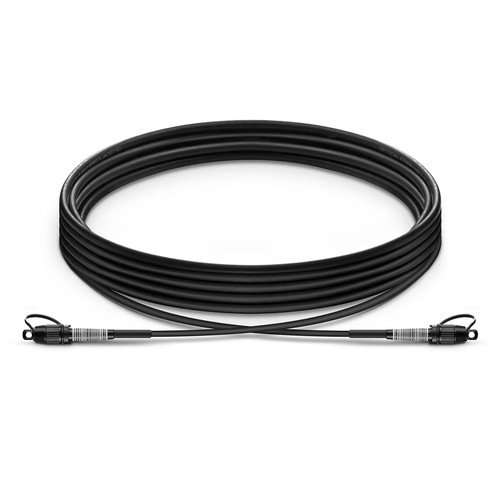
Malaysian upgrade projects can use this configuration where its interface and fiber map align with both the installed cabling and the new hardware. This fiber drop cable carries a sealed optical interface at the two terminations: hardened SC APC connectors, every IP68 rated, mate directly with the outdoor terminal ports at the two sides of the link. It serves the spans where neither end is indoors: terminal to terminal, closure to pedestal, pole to facade box. The completed cable is the round 5.0mm outdoor construction with one G.657.A2 bend-insensitive OS2 fiber, rated at 1200N tensile load and 1200N crush resistance, factory terminated and manufactured to the ordered length.
Product Highlights
- Hardened SC APC (IP68) at both ends
- Sealed tool-less mating with outdoor terminal ports
- Round 5.0mm construction, 1200N tensile and crush rating
- G.657.A2 bend-insensitive fiber, 20/10D cable bend radius
- Insertion loss ≤0.3dB, return loss ≥60dB
- Manufactured to the ordered route length
Specifications
| Connector A | Hardened SC APC (IP68) |
|---|---|
| Connector B | Hardened SC APC (IP68) |
| Fiber Mode | OS2 9/125µm |
| Wavelength | 1310/1550nm |
| Fiber Count | 1 Fiber |
| Fiber Grade | G.657.A2 |
| Min. Bend Radius (Optical Fiber) | 7.5mm |
| Min. Bend Radius (Fiber Cable) | 20/10D (Dynamic/Static) |
| Cable Outside Diameter (OD) | 5.0mm |
| Cable Jacket | Low Smoke Zero Halogen (LSZH) |
| Tensile Load | 1200N (Short Term) |
| Crush Resistance | 1200N/100mm (Short Term) |
| Insertion Loss | ≤0.3dB |
| Return Loss | ≥60dB |
| Attenuation at 1310nm | ≤0.36dB/km |
| Attenuation at 1550nm | ≤0.22dB/km |
| Operating Temperature | -20 to 70°C (-4 to 158°F) |
| Storage Temperature | -10 to 50°C (14 to 122°F) |
Sealed at both ends for outdoor spans
Some drop routes never come indoors: a distribution terminal on the pole feeding a facade box across the street, a closure feeding a pedestal in a garden plot, a handhole link between two sealed enclosures. On those spans the two connectors live outdoors, and the two need the sealed interface. The hardened-to-hardened drop cable comes with exactly that: every end threads onto a matching terminal port and closes to IP68, meaning that the installed link is environmentally sealed without a single field splice or enclosure seam.
The 1200N round construction
Spanning between structures asks more of a cable than a wall entry does. The round 5.0mm construction carries its strength members around the core, rated at 1200N short-term tensile load and 1200N crush resistance per 100mm, roughly three times the rating of the flat drop construction. The completed cable tolerates the tension of an aerial sag, the incidental pull during the install through conduit, and the crushing loads of duct sharing and ground work. The 20/10D cable bend radius keeps the glass safe at pole hardware and enclosure entries.
G.657.A2 glass in sealed hardware
Sealed terminals and pedestals are compact inside, and the fiber within them bends sharply around splice trays and port fields. G.657.A2 bend-insensitive glass tolerates a 7.5mm fiber bend radius, meaning that the pigtail section inside the hardware can generally be dressed tightly without adding loss. The glass is fully compatible with the G.652.D feeder plant upstream, keeping the channel budget of the access network unchanged.
Repeatability for network builds
Terminal-to-terminal links repeat across a network by the hundreds. Specifying one cable construction, one connector pair and a length plan per span type lets the factory build each link identically, with the same optical test record on every. Crews install the same assembly at each location, spares reduce to a handful of length variants, and the documentation for the whole rollout follows one template.
Built to the measured route length
Each drop cable in this family is manufactured to the length stated with the order rather than picked from fixed stock sizes, as last-mile routes differ from a few meters to well over a hundred. The completed cable is manufactured to the length stated with the order; measure the span including the sag allowance on aerial routes and the dressing slack inside the two enclosures. Specifying the measured route length avoids the two the slack storage problem of an overlong cable and the strain risk of one that is too short.
Testing and inspection practice
Each finished assembly is terminated with precision zirconia ferrule hardened connectors and optically tested as a whole cable: insertion loss is verified against the 0.3dB ceiling and return loss against the 60dB minimum. The two connectors are checked for seal integrity as well as optical behaviour, meaning that the delivered link can generally be threaded onto the terminal ports and put into service without on-site rework.
Ordering and Customization Support
Refer to the hardened-to-hardened drop cable family when seeking a quotation and state the span length, terminal types and unit count per length. For mixed builds with a standard SC APC end for the subscriber side, or other hardened connector styles, send the site need with the inquiry and the factory will determine the manufacturable specification before the product is built. For Malaysian upgrades, our team can compare the requested build with the existing environment before production begins.
Transceivers
Malaysia Fiber Optic Supplier
Malaysia Fiber OpticsFactory Address: Block 5, Wangtang Industrial Park,Nanshan Area, Shenzhen,China
Malaysia Office: 68000 Ampang,
Selangor, MYhttps://www.fiberoptic.com.my